
Federal Releases Serving Goodhue
The Federal Bureau of Prisons is a nationwide system for people serving federal prison sentences. Research found no BOP prison in Goodhue County. A person with a Goodhue connection may therefore be housed anywhere the federal agency assigns them. The local Adult Detention Center roster cannot show the complete federal prison history, and leaving the Goodhue County jail can mean transfer to federal authorities rather than release into the community.
A true BOP release ends physical custody in a federal prison. The person may enter federal supervised release, which is a court-ordered period in the community, or may face another lawful custody claim. State and local warrants, a different sentence, immigration custody, and other agency action are outside the BOP locator's answer. The federal court judgment and later docket entries explain the sentence and supervision terms. The locator answers a narrower question: whether the person remains in BOP custody and what release date the BOP result displays.
Goodhue County records still matter when the federal path started with a local arrest or transfer. The county roster may document current ADC custody only while the person is listed. A transfer entry or court record can explain why the name disappeared. The full Goodhue County released inmate search describes that local evidence trail, while the federal locator becomes the main public source once a sentenced person enters BOP custody.
Confirm a Federal BOP Release
The official BOP Inmate Locator covers federal prisoners from 1982 to the present. It accepts either an identifying number or a name search. Number searches can use a BOP Register number, DCDC number, FBI number, or INS number. A name search permits race, age, and sex filters. Those filters help separate similar names, but the result still must be matched to the correct person.
Use the result as a federal custody record, not as a universal freedom check. The BOP updates public locator data daily, and sentence recalculation can cause a temporary mismatch. A future release date is projected rather than final. Exact-name issues also create false negatives, so try known variants and an identifying number before concluding that no record exists.
- Choose number search when a federal identifier is known. It is usually the clearest way to avoid a same-name match.
- Otherwise enter the full name and add only reliable filters. Do not guess at age, race, or sex merely to force a result.
- Open the matching line and compare the name, register number, age, race, and sex with the federal case or another stable record.
- Read the release date and location together. Preserve the exact wording rather than paraphrasing a transfer or unresolved status as release.
- Check the federal court docket for the judgment, supervision term, later order, or other custody context that the locator does not supply.
A result that cannot be matched confidently should remain unresolved. A federal case number, judgment, or BOP register number provides a stronger bridge than a name alone. If the person never served a BOP sentence, a federal pretrial release may appear in the court docket without any BOP locator result.
Note: A federal release date confirms the BOP event only; it does not rule out supervision or custody held by another agency.
Read Federal Release Results
BOP result language should be kept exact because each label answers a different question. A past release date paired with location “RELEASED” means the person is no longer in BOP custody as of that date. “Not in BOP Custody” is also limited to BOP custody. Neither phrase proves that the person has no federal supervision, no state or local case, and no immigration hold.
Two other labels are often mistaken for release. “IN TRANSIT” describes movement within the federal system. It does not mean the person entered the community. “UNKNOWN” can mean that the term or release point is not determined in the locator. It is not a release finding. A future date can change because federal sentence information is recalculated.
| BOP result | What it supports | What it does not prove |
|---|---|---|
| RELEASED with past date | No longer in BOP custody as of the shown date | End of supervision or absence of other custody |
| Not in BOP Custody | BOP is not the present custodian | Community release from every system |
| IN TRANSIT | Federal movement is underway | Release to the community |
| UNKNOWN | The public locator lacks a settled term or date | A completed release |
| Future release date | A projected federal release date | The final date after all recalculation |
The difference matters in Goodhue County. A name can vanish from the local jail list after federal pickup while the BOP result later shows transit or a federal facility. That sequence reflects a change of custodian. It should not be labeled a local community release.
BOP Federal Release Search
The official federal locator search screen shows the two public search routes and the identifiers that BOP accepts. The captured form is useful for planning a careful search before entering a name.
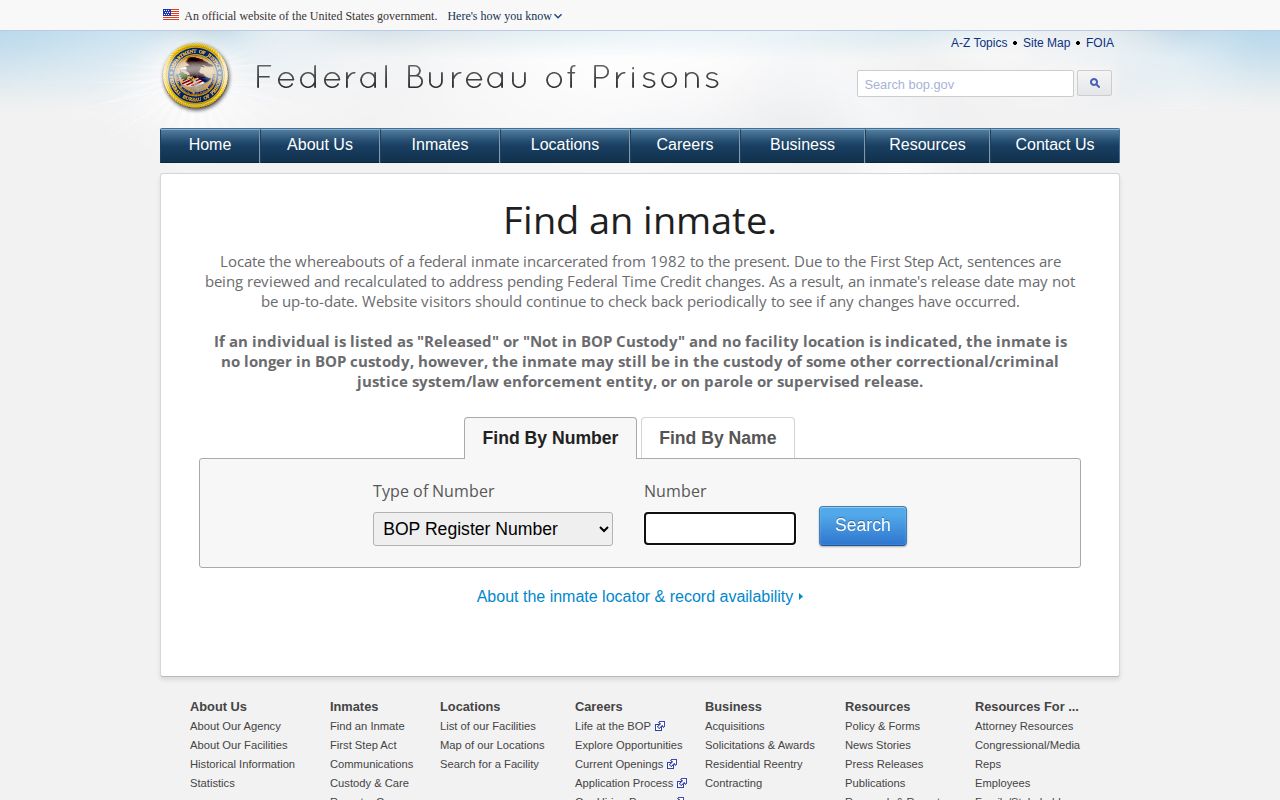
The image confirms that the tool is a BOP database rather than a Goodhue County roster. It also shows why an identifying number is preferable when several people share a name.
Federal Release Records Requests
The public locator is the first stop, but it is not the full federal prison file. A detailed record may require the BOP Freedom of Information Act process. A focused request should reasonably describe the existing record, identify the person with enough detail, and state the approximate custody or release period. BOP may require identity certification or a DOJ-361 authorization, and privacy exemptions can limit what a third party receives.
Files for federal imprisonment before 1982 may require research through the National Archives federal prison records process. The public BOP locator does not cover that earlier period. For a modern sentenced person, request existing public information that reflects entry into federal custody, institution history, release date, and release status rather than asking the agency to create a new explanation.
Federal BOP Record Paths
Current and historical locator coverage
Federal Bureau of Prisons Inmate Locator
Coverage begins with 1982 records
Detailed federal prison records
BOP FOIA
Use identity and authorization requirements shown by the agency
Older federal prison files
National Archives and Records Administration
Search archival prison records for pre-1982 custody
The court path serves a different need. A federal judgment can state the sentence and supervised release term. Later docket entries may document a release order, violation, revocation, or amended judgment. The federal electronic court-record system supplies that docket route. It is especially important for federal pretrial custody because the U.S. Marshals Service may have held the person without a BOP sentence.
Note: BOP FOIA, archival records, and a federal court docket are separate sources; each preserves a different part of the release history.
Goodhue Federal Custody Boundaries
The U.S. Marshals Service handles many federal pretrial movements and prisoner transports. It has no public historical release locator comparable to BOP's tool. When a Goodhue County arrest becomes a federal case, the federal docket and a targeted USMS FOIA request may be the correct sources. FOIA requires a request for reasonably described existing records. It does not require an agency to create a release certificate or answer a broad research question.
Agency ownership sets the search path. The Goodhue County ADC can speak to a local custody transaction. BOP can speak to sentenced federal prison custody. USMS records may address pretrial detention or transport. ICE handles civil immigration detention. A person can pass through more than one system, so the dates should be arranged in order and the receiving agency identified at each handoff.
| Custody question | Primary public path | Historical fallback |
|---|---|---|
| Goodhue County jail release or transfer | ADC or Sheriff Records | County data request and court case |
| Sentenced federal prison release | BOP Inmate Locator | BOP FOIA or National Archives |
| Federal pretrial release | Federal court docket | Targeted USMS FOIA request |
| Immigration custody after transfer | ICE detainee locator | Responsible ERO office |
This comparison prevents the most common error: treating absence from one database as proof of release from all custody. No single federal or Goodhue County tool supplies a complete cross-system ledger.
Federal BOP Release Scope
A sound federal release finding states only what the evidence supports. If the BOP locator displays a past release date and “RELEASED,” report the BOP release date and retain the result's exact wording. Then use the federal judgment to check whether supervised release followed. Supervised release means the person lives in the community under terms set by a federal court. It is not physical prison custody, but it is also not the end of every legal obligation.
When the result says “Not in BOP Custody,” avoid converting that phrase into “free.” Search the known state or local case if another custody path is plausible. For a Goodhue County connection, compare the ADC or court transfer date with the federal record. If immigration custody is plausible, use ICE's system. Each added source should resolve a concrete gap rather than repeat the same name search.
Older or incomplete federal results need a records trail. Pre-1982 files belong on the National Archives path. Detailed modern BOP records belong in a focused FOIA request. A pretrial release belongs first in the federal court docket. These distinctions preserve the actual release event without overstating what a public locator can prove.